

Agent
The Agent struct is the main entry point. It owns the conversation state and
drives the prompt → LLM → response loop.
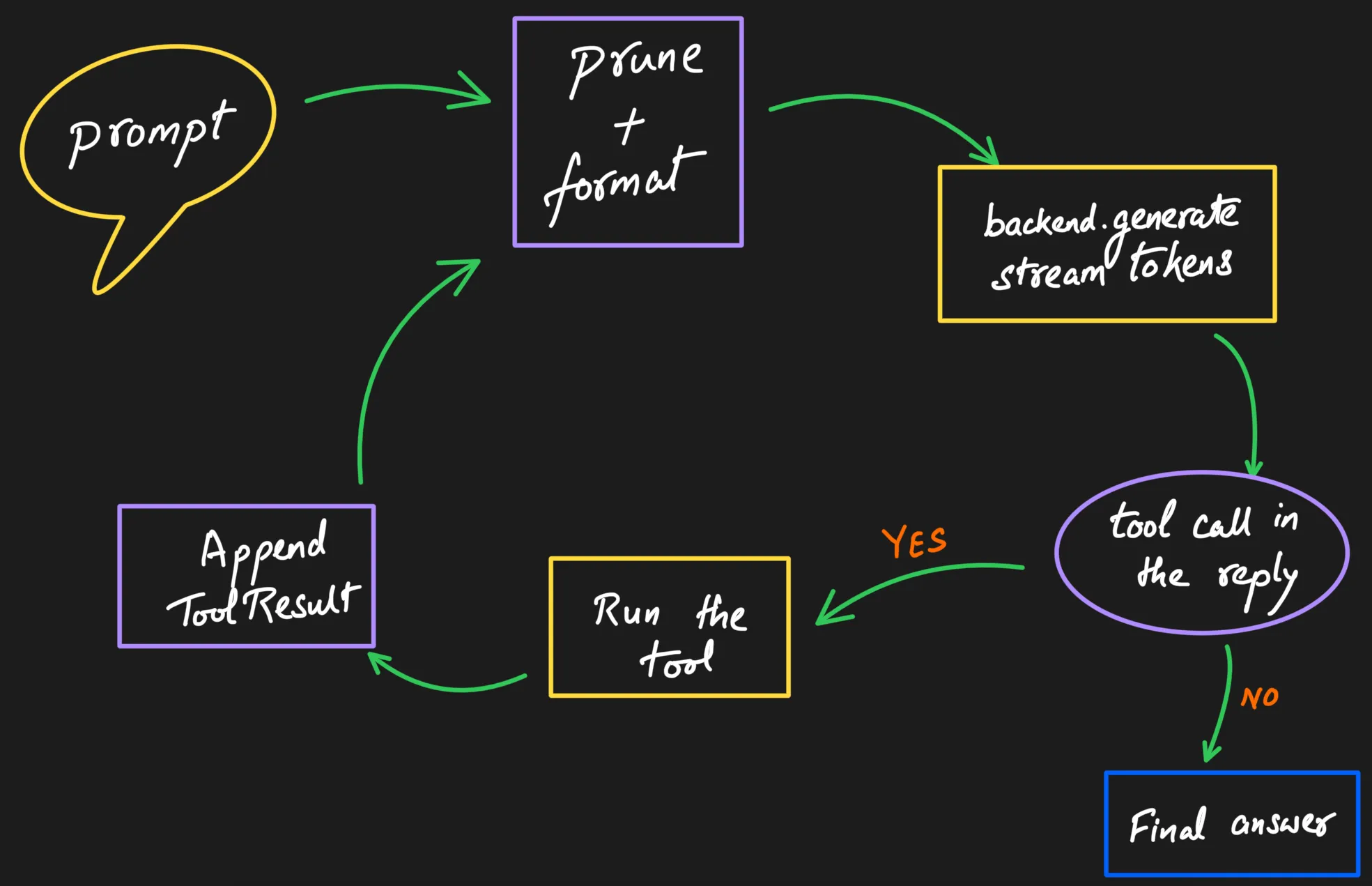
One call to prompt drives the whole cycle, looping on tool calls until the
model returns a tool-free answer (bounded by max_tool_iterations, default 8).
Creating an agent
Section titled “Creating an agent”use orion_core::{Agent, AgentConfig, InferenceParams, ContextConfig};
let mut agent = Agent::new(AgentConfig { system_prompt: "You are a coding assistant.".into(), inference_params: InferenceParams { max_tokens: 4096, temperature: 0.4, context_size: 8192, n_threads: 6, }, context_config: ContextConfig { max_context_tokens: 8192, max_response_tokens: 4096, ..Default::default() }, ..Default::default()});AgentConfig carries the system prompt, inference parameters, context
configuration, and max_tool_iterations (the cap on tool-loop rounds, default
8). Everything has a sensible Default, so Agent::new(AgentConfig::default())
is a valid starting point.
Running a turn
Section titled “Running a turn”There are two ways to drive a turn:
agent.prompt(text, backend, tx)- you create thempsc::unbounded_channel::<AgentEvent>()and pass the sender. The agent streams events into it and returns when the turn is done.agent.prompt_stream(text, backend)- the agent creates the channel for you and returns(receiver, future). Drive the future while you drain the receiver.
Both run the full context → generate → tool loop described in Architecture.
Changing settings on the fly
Section titled “Changing settings on the fly”agent.set_system_prompt("You are a pirate.");agent.set_inference_params(InferenceParams { temperature: 1.2, ..Default::default() });Managing the conversation
Section titled “Managing the conversation”agent.clear(); // Reset the conversationagent.replace_messages(saved_messages); // Restore a saved conversationBecause conversation state is just a Vec<Message>, you can persist it and
restore it later with replace_messages - useful for resuming sessions.
Aborting a generation
Section titled “Aborting a generation”agent.abort();abort signals the shared AtomicBool the backend checks each token, so a
running generation stops promptly and the call returns with
CoreError::Aborted.
Tools and templates
Section titled “Tools and templates”The agent also owns the registered tools and the active chat template:
agent.set_tools(vec![Box::new(MyTool)])- see Tools.agent.set_approval_hook(Arc::new(MyHook))- authorize tool calls before they run; see Gating tool calls.Agent::with_template(config, template)/agent.set_template(template)- see Templates.